


Exposing Viruses’ Weak Points: How Structural Biology Works
What enables a virus to recognize a cell, enter it, and begin replicating? Prof. Moshe Dessau of the Dangoor Center for Personalized Medicine studies this process at the atomic level. In this interview, he explains how the structure of viral proteins can help in the development of vaccines and treatments, what research on antibodies against COVID-19 has revealed, and how scientists are already preparing for a virus that could cause the next pandemic.
The shape of an object can tell us a lot about its function: the blades of a pair of scissors tell us that they are designed to cut, while the teeth of a key determine which lock it can open. The same principle applies in the world of molecules: their structure affects how they function and the interactions they can form.
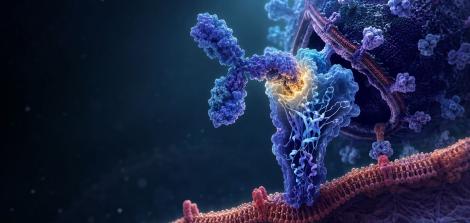
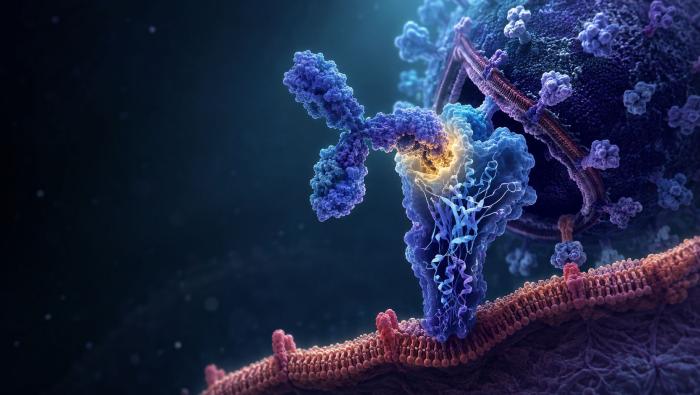
Proteins are macromolecules (molecules made up of dozens to thousands of building blocks called amino acids), and the relationship between their structure and function is critical to every biological process, including viral infection. Proteins on the surface of a virus can recognize a target cell and bind to it by interacting with proteins on the cell. They then change shape to perform a different function: helping the virus introduce its genetic material into the host cell.
Prof. Moshe Dessau and his research team study the structure of viral proteins at each of these stages to understand how the changes they undergo allow the virus to enter the cell and replicate. This understanding could help researchers develop new strategies for stopping infection.
Prof. Dessau is a structural biologist, biochemist, and researcher at the Dangoor Center for Personalized Medicine. He serves as Vice Dean for Preclinical Education and heads the Laboratory of Structural Biology of Infectious Diseases at Bar-Ilan University’s Azrieli Faculty of Medicine in the Galilee. His research focuses on how viruses enter cells, viral evolution, and groups of viruses that can cause severe disease. His work centers on understanding which parts of a virus’s structure are essential to the infection process and using this knowledge to find ways to stop infection.
 “I asked myself what the next pandemic could be.” Prof. Moshe Dessau
Seeing the Mechanism: What Is Structural Biology?
Structural biology is a field of biology that examines the three-dimensional structure of molecules, including proteins, down to the atomic level. Studying these structures allows researchers to understand the role of different parts of a molecule and how they work together.
In Prof. Dessau’s lab, this approach is used to study the proteins that help viruses enter cells. “We’re trying to understand what the protein looks like initially, how it changes when it binds to the cell, and how each change in its structure enables the next stage of the infection process,” Prof. Dessau explains.
How do you reconstruct the sequence of events in the activity of a viral protein?
“We examine the same protein at several stages: before it encounters the cell, after it binds to the cell, and as it changes shape to allow the virus to enter. Each structure is like a snapshot at a different stage of the process. By putting these snapshots together, we can reconstruct the sequence of steps in the protein’s activity and understand the virus’s overall mechanism of entry.”
What can we learn from the structure of viral proteins?
“Studying the structure helps us identify which regions of the protein are essential to its function. These may be regions that allow it to bind to other proteins in the cell, or regions that change in response to different environmental conditions (pH, salt concentration, viscosity, etc.). These regions are potential weak points: if we can block them, we may be able to inhibit the protein’s activity and disrupt the infection process.
“Once we identify these weak points, we can look for substances that bind to the viral protein and interfere with its normal function, ultimately preventing infection. We also collaborate with researchers who have the technology needed to take our findings to the next stage, such as developing treatments or vaccines.”
From recognition to replication: How does a virus infect a cell?
The infection process begins when a virus encounters a cell, and whether infection occurs depends on the compatibility between them. Prof. Dessau studies the conditions that determine whether a virus can complete the infection process. “Although a virus carries genetic material, it cannot replicate on its own,” he explains. “To produce new viruses, it relies on the cell’s replication and translation machinery. That’s why it’s important to understand not only how a virus enters a cell, but, just as importantly, what happens once it gets inside.”
How does a virus enter a cell?
“In our lab, we mainly study enveloped viruses, in which the genetic material is surrounded by a membrane, or lipid layer. Proteins on this membrane perform two key functions during entry into the cell: they recognize the appropriate cell and promote fusion between the viral membrane and the cell membrane.
“First, an envelope protein binds to a specific receptor on the surface of the cell, much like a key fitting a lock. This compatibility determines which cells the virus can infect. SARS-CoV-2, the virus that causes COVID-19, for example, recognizes a receptor that is abundant on cells in the respiratory system, while the hepatitis C virus recognizes liver cells. Once the protein binds to the receptor, it changes shape and causes the two membranes to fuse. The process can be compared to two soap bubbles merging into one. This fusion allows the virus’s genetic material to enter the cell intact, without leaking into the extracellular space.”
What determines whether a virus can complete the infection process?
“We use two terms: a susceptible cell and a permissive cell. A susceptible cell is one that the virus can enter because it has the appropriate receptor. A permissive cell is one that allows the virus to replicate because it has the cellular machinery required for replication. To complete the infection process, the virus needs a cell that is both susceptible and permissive. Some cells allow the virus to enter but not replicate, while others have the machinery needed for replication but lack the receptor the virus needs to enter.”
At what stages can we intervene in the infection process?
“The most effective approach is to stop the virus before it enters the cell. The immune system produces antibodies that recognize specific regions of the virus’s envelope proteins and bind to them. This binding can interfere with the virus’s function and prevent it from infecting the cell. Understanding how different antibodies work can help us design vaccination and treatment strategies against the virus.
“If the virus has already entered the cell, we can try to interfere with later stages of the infection cycle. Inside the cell, the virus expresses genes and produces proteins, each with a different role. We can develop substances that inhibit these proteins, slow viral replication, and help reduce the severity of the disease.”
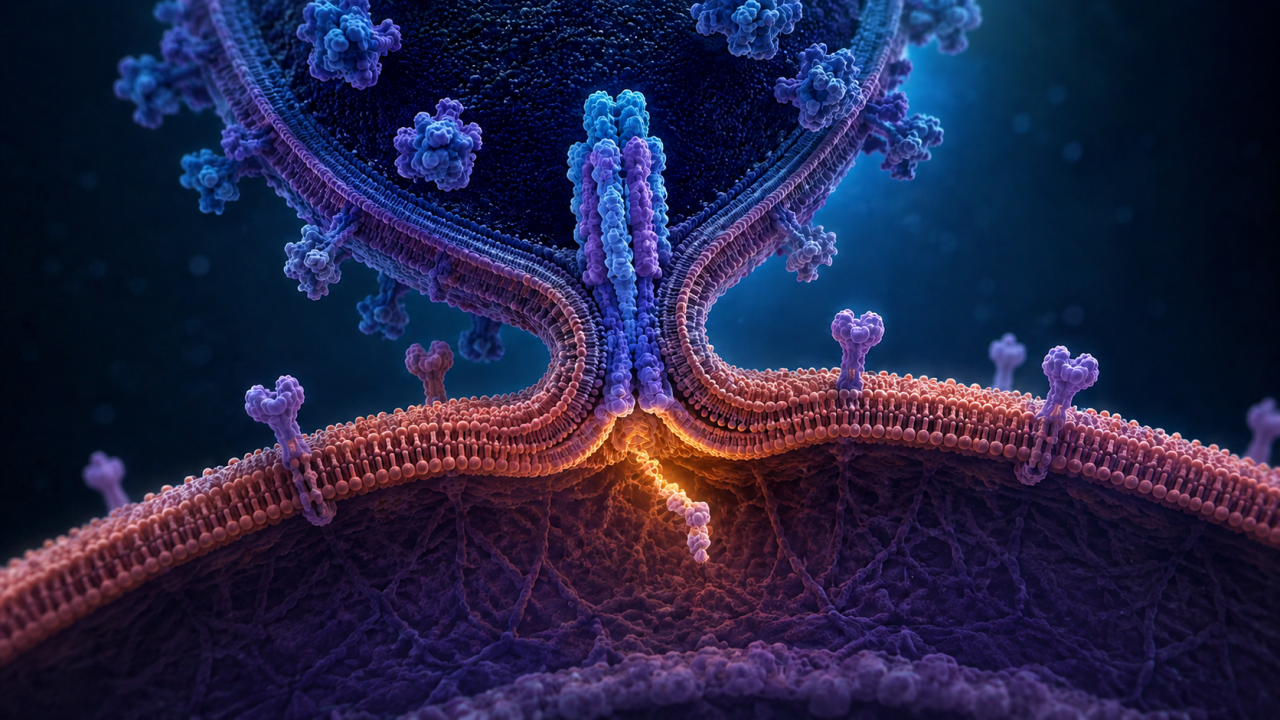 Membrane fusion allows the viral genome to enter the cell intact
From COVID-19 to the next pandemic: Prof. Dessau’s research
In Prof. Dessau’s lab, researchers study both well-known viruses and viruses that have received relatively little research attention. Their work involves deciphering the structures of the proteins that allow viruses to infect cells, studying antibodies that can stop infection, and examining the changes that allow viruses to spread between different hosts.
One of the lab’s main areas of research is bunyaviruses, a large and diverse group that includes viruses capable of causing severe disease. “We want to understand both the weak points of viruses we already know and the mechanisms of viruses that could become important in the future,” says Prof. Dessau. “The sooner we gain this knowledge, the faster we’ll be able to respond when there is a need for a treatment or vaccine.”
Why did you choose to focus on bunyaviruses?
“When I established the lab, I asked myself what the next pandemic could be. I wanted to study viruses that are largely unknown in Israel and currently receive little research attention, but could become important in the future. Bunyaviruses are a group of more than 500 enveloped RNA viruses. The group includes families of viruses that infect humans and other mammals, as well as viruses that infect birds, snakes, plants, and single-celled parasites. They have only a small number of genes, yet some of them can cause severe disease.”
What is the focus of your research on bunyaviruses?
“We’re looking at two main questions: how bunyaviruses enter cells, and what changes allow them to expand their host range. The first study we published from our lab examined the structure of a hantavirus envelope protein involved in membrane fusion during entry into the cell. This work, together with studies by other research groups, provided a basis for the structure-based design of vaccines and treatments.
“We also study the evolution of bunyaviruses. For example, we compare viruses that infect plants with viruses from the same group that infect humans, and try to understand which structural changes allowed them to expand their host range over the course of evolution.”
Why is it important to study these viruses now?
“Many of these viruses are associated with diseases that occur mainly in developing countries and communities living in poverty, and research into them receives limited resources. It’s important to understand how these viruses cause infection before a widespread outbreak occurs, so that we have the knowledge needed to develop a treatment or vaccine if they become a significant threat. COVID-19 is a good example. The knowledge gained over the years from research on SARS-CoV following the 2003–2004 outbreak gave us many of the tools we needed to understand how the virus that caused COVID-19 infects cells and replicates.”
Alongside your work preparing for future viruses, you also studied antibodies against COVID-19. What did you discover?
“We studied two rare and highly potent antibodies that were isolated from people who recovered from COVID-19 during the first wave in Israel. They can neutralize a wide range of variants, including Omicron subvariants. The antibodies bind to a hidden region of the spike protein that is evolutionarily conserved. The spike protein is found on the virus’s envelope and allows it to enter cells.”
"This binding destabilizes the spike protein and causes it to change shape prematurely. The change is irreversible, so when the virus reaches the receptor on the surface of the cell, it can no longer bind to it, preventing infection. Because this region of the spike protein is evolutionarily conserved and remains unchanged across different variants of the virus (Alpha, Beta, Delta, Omicron, etc.), it could serve as a target for developing antibodies or vaccines that are effective against a broader range of variants.”
What is the connection between virus research and personalized medicine?
“It starts with the fact that different people may respond differently to the same virus. Each person has their own genetic makeup, and their ability to fight off the virus is also influenced by their lifestyle and overall health. These factors affect the immune response and the range of antibodies the body produces.
“Some antibodies are very common, while others are extremely rare but can be particularly effective. The two antibodies we studied are a good example: they are rare in a patient’s antibody repertoire, but they can recognize a highly conserved region of the virus and neutralize many variants. By studying why certain people produce a particularly effective immune response, we can learn from these responses and explore how these antibodies could be used as treatments, or develop treatments based on their mechanism of action.”
How important is collaboration in this field of research?
“Our research relies heavily on collaboration across different fields. Our expertise is in structural biology and biochemistry, while other researchers bring expertise and tools from molecular virology, cell biology, and other areas. Combining these different areas of expertise allows us to study the same mechanism from different angles and gain a more complete understanding.”
Finally, how do you see the future of structural biology?
“This is a very exciting time for the field. Artificial intelligence-based tools such as AlphaFold can help us predict protein structures and formulate research hypotheses. At the same time, these tools can make mistakes and produce incorrect predictions. That’s why a computational prediction is only a starting point. We then need to test experimentally whether the predicted structure actually reflects reality and whether the hypotheses we formulated based on it are correct.”
Last Updated Date : 30/09/2026