



Protein Folding
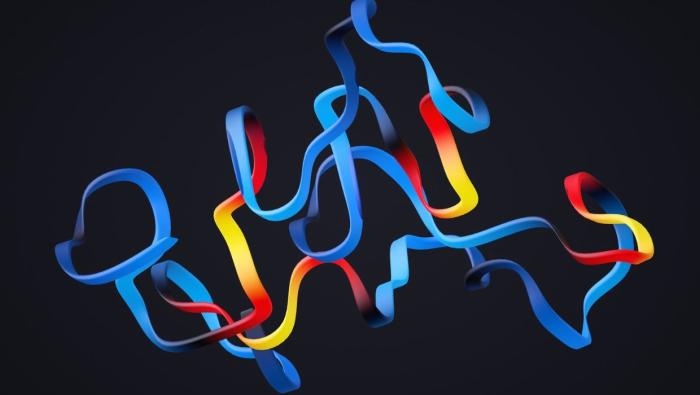
Protein folding is a physical process in which the chain of amino acids that make up proteins takes on its stable, active three-dimensional structure.
A protein begins as a kind of long, one-dimensional "chain," like a long thread. For the protein to perform its functions in the body, it must fold into a very precise three-dimensional shape. This can be compared to the way a sheet of paper takes on a particular shape through origami folding.
A protein undergoes a folding process through three or four levels of structure:
- The primary structure consists of a sequence of amino acids and looks like a string of beads.
- In the secondary structure, the first folds can be seen. The chain essentially forms a helix or folds into sheets known as beta sheets.
- In the tertiary structure, the complete three-dimensional structure has already formed. The small helices and sheets that have formed fold together into a globular or fibrous shape.
- The quaternary structure is not present in all proteins. It consists of several protein chains joining together to form a complex protein, such as hemoglobin.
At the end of the folding process, the protein is in its native state, the state in which it can begin to function in the body. The way a protein folds determines the role it will perform in the body. Almost every process in the body is carried out by proteins, from breaking down food to transmitting signals between cells.
There are situations in which protein folding fails or goes wrong. For example, when a protein that has completed the folding process is exposed to extreme conditions, such as high temperatures or high acidity, it loses its three-dimensional structure and returns to an inactive state. In addition, when proteins fail to fold properly at one of the stages, sticky deposits and damaged cells may form, leading to various diseases such as Alzheimer's or Parkinson's.
Questions and Answers
- How does a protein know how to fold?
A protein folds because of the forces acting on it, with the key lying in the chemistry of the amino acids that make up the protein:
• Some are hydrophobic ("afraid" of water): They will always tend to cluster in the interior of the protein, away from the watery environment of the cell.
• Some are hydrophilic ("water-loving"): They will face outward, toward the water in the cell.
• Electrical charges: Amino acids with opposite charges (+ -) will attract each other, while like charges (+ + or - -) will repel each other.
These forces cause the protein to fold spontaneously into the most stable shape, with the lowest free energy. Sometimes, the protein is assisted by special proteins called chaperones, whose role is to prevent the protein from sticking to other proteins while it is folding.
- What is the protein folding problem?
The protein folding problem is one of the greatest scientific challenges of the 20th and 21st centuries. The challenge was to figure out how a protein actually folds. In other words, how to take a protein's primary structural sequence, which we know how to read from DNA, and predict in advance, with mathematical and chemical precision, the three-dimensional shape into which it will fold. For about 50 years, scientists often had to invest months to years of laboratory work and considerable funding to determine the structure of a single protein.
- How is artificial intelligence (AI) related to protein folding?
In recent years, there has been a historic breakthrough in protein folding thanks to artificial intelligence. Google DeepMind developed AlphaFold, an AI model that largely solved the challenge of predicting a protein's structure. The algorithm can predict, with remarkable accuracy and in a short amount of time, the three-dimensional structure of almost any protein known to science. This breakthrough was so significant that its developers, Demis Hassabis and John Jumper, shared the 2024 Nobel Prize in Chemistry with David Baker.
- What is the difference between protein misfolding and denaturation?
Although both conditions impair protein function, there is a difference between them.
• Misfolding: A condition in which a protein folds incorrectly from the outset or changes its shape into a defective form due to a genetic mutation or a malfunction in the cell. This can cause it to become toxic or "sticky," as occurs, for example, in neurodegenerative diseases.
• Denaturation: A process in which a protein that was properly folded "unfolds" and loses its structure due to extreme environmental conditions, such as heat or acidity. This process can sometimes be reversed under mild conditions, but it often becomes irreversible when the unfolded proteins clump together, as happens when egg white hardens during cooking.
- What diseases can result from protein folding failure?
Proteins that haven't folded properly tend to stick to one another and form toxic deposits (aggregates) in the body. The best-known diseases associated with this are neurodegenerative diseases, in which the brain is unable to clear the defective proteins, such as Alzheimer's disease, Parkinson's disease, and Creutzfeldt-Jakob disease (CJD).
- Why is understanding protein folding important for drug development?
Most drugs work by acting on proteins. In many diseases, a particular protein is involved in the development of the disease, such as a protein that a virus uses to enter a cell or a protein that a bacterium exploits to cause an infection.
To affect the protein's activity, a drug needs to bind to it precisely. It is therefore important to know the protein's three-dimensional structure and how it is folded. The problem is that our bodies contain tens of thousands of different proteins, each with its own unique shape.
For many years, scientists knew which proteins were associated with diseases but didn't always know what they looked like in three dimensions. Without this information, it was very difficult to design new drugs, so the process relied heavily on trial and error.
The ability to predict the three-dimensional structure of proteins has changed this. Today, computers can be used to predict what a protein looks like, identify the regions where a drug can bind, and design molecules that fit those regions more precisely. This makes it possible to develop drugs more quickly, efficiently, and in a more targeted way.
Last Updated Date : 12/10/2026